
UniClear
An app for hard of hearing students
The Problem
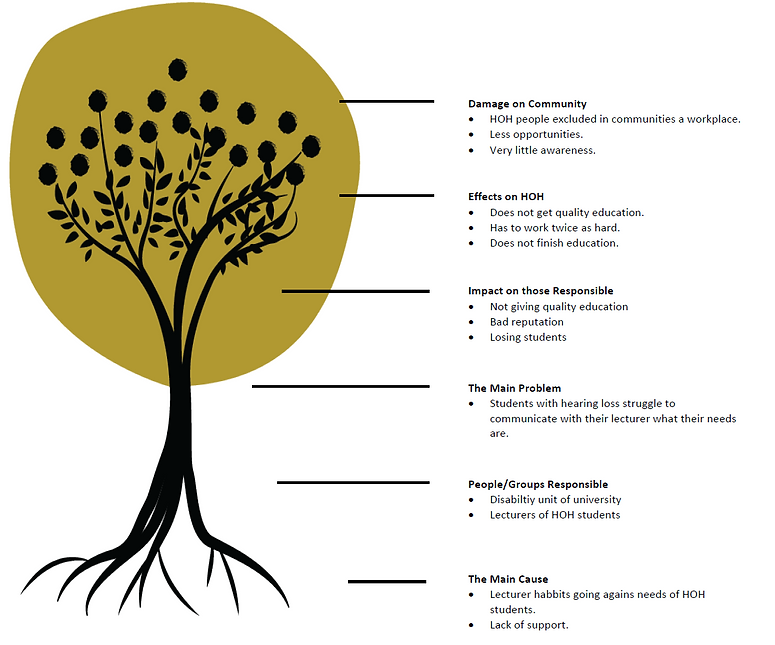
The majority of teaching methods used at universities in South Africa are not inclusive enough towards hard of hearing (HOH) students. These students often find it challenging to communicate with their lecturers due to the limited amount of support they receive from the university with regards to lecturer-student communication. This often creates stressful situations where these students have to continually remind a lecturer of their needs. Therefore, it makes it difficult for HOH students to adapt and flourish at university level.
The Process

INSPIRATION
-
Frame problem
-
Secondary research
-
Interviews
-
identify stakeholders
-
Participant observation
-
User survey
IDEATION
-
Share stories
-
Find themes
-
Ideation session
-
Frame solutions
-
Story board
-
Design prototype
IMPLIMENTATION
-
Final prototype
The Solution
The final design solution is an application and computer system working in tandem named UniclEar. The application aims to help HOH students communicate their needs to their lecturer and help the university monitor how the lecturers are adapting to the new inclusive-teaching method.
After conducting the user interviews, it became clear that HOH students do not need a new way to communicate but rather a way to navigate the situation and inform their lecturers of their preferred communication method. Since classes cannot be monitored at all times, the best way to give these students support is to provide them with the ability to provide feedback through the application and express themselves.
A HOH student can schedule all their classes on the application by selecting the lecturer and the lecture hall. The application will send an email to the lecturer the morning before class notifying the lecturer of which lecture the student will attend on that day. Once in the lecture hall, the student will select the subject they are attending on the application and automatically connect to the system on the computer. A selection of notification buttons (as suggested by the expert interviewees) will appear on the student's phone. The buttons are: talk slower, talk clearly, turn around or come to the front, monitor sound and mic.
When the student selects a button, an icon will appear on the projector. The icon will stay on the projector until the lecturer the student selects "issue resolved" on their phone when they feel the lecturer has corrected their mistake. After the class is over the student will select the "class done" button whereafter a five-star rating popup will appear. The popup will ask the student to rate their class experience with the rating not visible to the lecturer.
Workflow

Wireframes
Keep track of how lecturers are adapting to HOH student
Log classes and lecturers

Open class with buttons highlighting communication needs
Icon appears on phone and projector screen until lecturer has fixed the problem and student clicks "resolved"
Final Design
Study Limitations
After doing the research and starting the design, it was found that this solution can be significantly refined, given more time than this project allows. Due to time limitations and the inability to write code and create the application, further research could not be done into the real-life working of the application. Creating a prototype would not just be beneficial for the design of the application but also for witnessing the long term effects it may have with regards to the awareness and inclusivity of HOH students. It would also have been interesting to see how a partnership with an awareness campaign would have impacted the reach of the application and the message it supports.
While doing the interviews, good suggestions were given that were not implementable at the time due to a lack of time and resources. Creating a speech-to-text function for the application would be extremely beneficial. Further research would have to be done on the available ASR technologies and how leading hearing aid companies may be partnered with to make this a reality. It would also have been beneficial to do more research on how the product could be implemented – whether a dedicated system should be developed for a university or if an add-on (plug-in) to their existing system should be developed.
Impact of Design
Although there is a lot of available research on the lack of inclusivity towards HOH students, most of these studies lack in finding a solution. This study gives a new viewpoint on how to approach the lack of inclusivity towards HOH students. The study focuses on creating a support system for HOH students that go beyond student-lecturer communication.
People who are HOH are overlooked in so many ways in our society. This study shone new light on this situation in South Africa. Especially after talking to HOH students who experience these problems every day, it was illuminative to get a more in-depth insight into the experiences they have. Things that a hearing person would never think about, for example, when multiple people are speaking at the same time or a lecturer speaking while a video is playing can cause a problem for HOH students. We live in a world that heavily rely on the ability to hear. Even so, it is our responsibility to include those who cannot hear.